Episodes

Sep 7, 2025
Sep 7, 2025
2 min
The Academy and the saber have a long and rich history, dating back to the very beginning of USAFA’s existence. Most of the early Air Force Academy planners were in fact West Point graduates. They brought many of their programs, artifacts, and traditions to the new school in Colorado. Included in that category is the saber, which has been carried by wing, group, and squadron leaders while marching or participating in ceremonies. In 1961, only three years after the Academy moved from Lowry Air Force Base in Denver to its current location, cadets founded the Cadet Sabre Drill Team. Its mission was – and still is – to demonstrate professional military skills and discipline through the performance of intricate saber manual. One of the few U.S. military units that perform drills entirely with sabers, they delight audiences throughout the Rocky Mountain area and beyond. When I was on the AOG Board of Directors in the mid-1900s we demonstrated the importance of the saber in Academy culture. In this very room, we established the Academy’s first donor club, naming it The Sabre Society. For decades, graduating cadets have been able to purchase German-made sabers from the Cadet Store for their personal use. In 2008, the Association of Graduates took over that program, selling and renting sabers for use in weddings and other events. An exciting change in that process took place in 2024, when production of the edged weapons was brought home. Excalibur Outdoors, a sister company to Kilroy’s Workshop in Colorado Springs, has taken on the task of producing these items. This “Buy American” initiative will decrease shipping costs and permit greater interaction with the manufacturer.

Aug 17, 2025
Aug 17, 2025
29 min
In Part 2 of this 3-part series, Heritage Minute Special host, Lt. Col. (Ret.) Steve Simon ’77, gets his conversation started with Mr. Duane Boyle, recently retired USAFA architect, a position he held for many years. The two discuss Duane's role as the Academy’s Architect, his work and impact, specific projects, and their shared experiences having worked together over the years going back to the 1980's.
You don't have to wait for all parts to publish. You can listen to the full 1 hour and 22 minute conversation at your convenience here: https://mcdn.podbean.com/mf/web/49y8c5jbsc9aadew/HMS_PARTS_1-3_DUANE_BOYLEajqmk.mp3
The Heritage Minute Channel is a production of the Long Blue Line Podcast Network and presented by the U.S. Air Force Academy Association & Foundation

Aug 3, 2025
Aug 3, 2025
2 min
Do you know who the U.S. Air Force Academy’s Stillman Field is named after? What about the milestones that take place there? Do you know what the mass of lush green grass’s name was before, in 1994, it earned its current moniker? Find the answers to these questions (and more you didn’t know you had) in this Heritage Minute.

Jul 20, 2025
Jul 20, 2025
35 min
In this Heritage Minute Special, Lt. Col. (Ret.) Steve Simon ’77 is joined by Col. (Ret.) Max Miller ’59, a proud member of the U.S. Air Force Academy’s first graduating class. They discuss a significant event that occurred 70 years ago, as well as Col. Miller’s long and distinguished service to the Air Force and the USAFA community.
The Heritage Minute Channel is a production of the Long Blue Line Podcast Network and presented by the U.S. Air Force Academy Association & Foundation

Jul 8, 2025
Jul 8, 2025
2 min
From sweat-soaked pages in Jacks Valley to ceremonial handoffs at the Acceptance Day Parade, Contrails is more than a handbook — it's a rite of passage at the U.S. Air Force Academy. Dive into the legacy in this edition of Heritage Minute!
The Heritage Minute Channel is a production of the Long Blue Line Podcast Network and presented by the U.S. Air Force Academy Association & Foundation

Jun 15, 2025
Jun 15, 2025
28 min
In Part 2 of this 3-part series, Heritage Minute Special host, Lt. Col. (Ret.) Steve Simon ’77, gets his conversation started with Mr. Duane Boyle, recently retired USAFA architect, a position he held for many years. The two discuss Mr. Boyle's role as the Academy’s Architect, his work and impact, specific projects, and their shared experiences having worked together over the years going back to the 1980's.
You don't have to wait for all parts to publish. You can listen to the full 1 hour and 22 minute conversation at your convenience here: https://mcdn.podbean.com/mf/web/49y8c5jbsc9aadew/HMS_PARTS_1-3_DUANE_BOYLEajqmk.mp3
The Heritage Minute Channel is a production of the Long Blue Line Podcast Network and presented by the U.S. Air Force Academy Association & Foundation
May 31, 2025
May 31, 2025
3 min
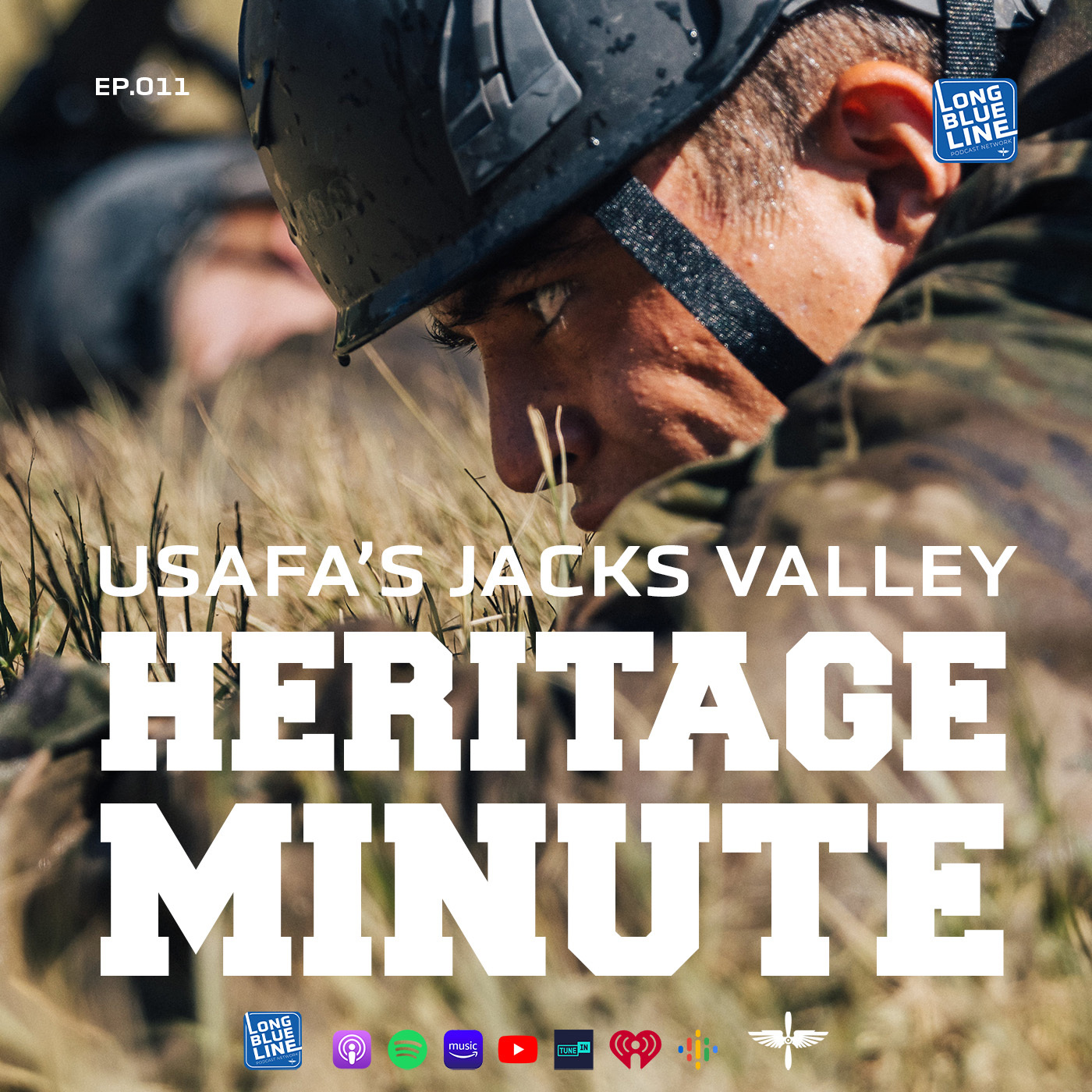
For graduates and cadets who trained here as basics, Jacks Valley will always occupy a special place in our memories. Here, we crawled in the mud, fought with pugil sticks, experienced tear gas, climbed obstacles, and did many other things for the first time in our lives. The Jacks Valley real estate was not part of the originally envisioned Academy installation. Prescient planners, however, wanted more land as a buffer. They feared that in decades to come, development and population encroachment would press up against the Academy. Of course, time has proven them to be correct. They added one valley to the south – Pine Valley – and one to the north – Jacks Valley. This enclave gets its name from the people who were on the land before the Academy’s arrival: Cleo and Zelda Jack, who had owned the 480-acre ranch since 1942. Ironically, they were only in the valley that now bears their name because they had been ousted from their previous ranch. The Jacks moved to Colorado from the Socorro, New Mexico, area after their property was acquired by the government to make room for atomic bomb development and testing. While the Academy used the valley for other military purposes – a skeet range opened here on 28 May 1960 – it wasn’t until 1966 that it became the Basic Cadet Training encampment. On 25 July 1966, members of the Class of ’70 marched to the training site from the Cadet Area, claiming the distinction of being the first class to have the Jacks Valley experience we know today. They received training in individual combat techniques, outpost duties, day and night patrols, fire and movement, individual firing positions, and first aid. While the general experience has endured, training has evolved, and other changes have taken place. For example, basics no longer pitch tents to sleep in. The Jacks Valley Mitchell Hall is also a building rather than a tent. In 2019, something new and exciting for graduates began: participation in the annual Jacks Valley March Back. That year, approximately 200 Academy graduates were the first alums to accompany basics and their cadre on their return to the Cadet Area from Jacks Valley. Grads ranging from the Classes of 1961 to 2019 marched with members of the Class of ’23 that day. Thirty-one members of the Class of ’59, at USAFA to commemorate the sixtieth anniversary of their graduation, awaited them at the Class Wall. The tradition continues to this day.
The Heritage Minute Channel is a production of the Long Blue Line Podcast Network and presented by the U.S. Air Force Academy Association & Foundation

May 18, 2025
May 18, 2025
27 min
In Part 1 of this 3-part series, Heritage Minute Special host, Lt. Col. (Ret.) Steve Simon ’77, gets his conversation started with Duane Boyle, recently retired USAFA architect, a position he held for many years. The two discuss Duane's role as the Academy Architect, his work and impact, specific projects, and their shared experiences having worked together over the years going back to the 1980's.
You don't have to wait for parts 2 and 3 to publish. You can listen to the full 1 hour and 22 minute conversation at your convenience by CLICKING HERE
Thank you for listening!
The Heritage Minute Channel is a production of the Long Blue Line Podcast Network and presented by the U.S. Air Force Academy Association & Foundation

May 4, 2025
May 4, 2025
2 min
In August 1958 when the Academy completed its move from Lowry Air Force Base in Denver to this permanent location, the cadets first accessed the cadet area by marching up this ramp.

Apr 20, 2025
Apr 20, 2025
1 min
The Air Force Academy cemetery is the only active base cemetery in the Air Force. In that regard, the USAFA cemetery is similar to the West Point and Annapolis cemeteries, which are also operated by their parent services, and the Arlington National Cemetery, which is administered by the Army. Consequently, the Academy cemetery has unique criteria for burial eligibility is outlined in Headquarters United States Air Force Academy instruction 34-501, which was published on 13 November, 2018. There are several exceptions and qualifiers, but the main categories of people eligible for burial at USAFA are USAFA cadets, Air Force military personnel assigned at USAFA at the time of their deaths. USAFA graduates all active duty and retired Air Force four star generals and lieutenant generals, specific former Academy senior staffers, original cadre from the Lowry days and mid-70s air training officers who supported the enrollment of the first female cadets, specific relatives of eligible members and Medal of Honor and Air Force Cross recipients. The instruction also has a waiver process. The 10th Air Base Wing Commander can disapprove a request for exception, but only the superintendent can approve an exception. These criteria and acres of space to expand ensure that eligible individuals can continue to be buried here far into the future.
The Heritage Minute Channel is a production of the Long Blue Line Podcast Network and presented by the U.S. Air Force Academy Association and Foundation

Apr 20, 2025
Apr 20, 2025
2 min
The Air Force Academy cemetery has breathtaking natural beauty and an exceptionally impressive roster of people who have chosen it as their final resting place. It also holds a large number of important structures. Most visible is the memorial pavilion. After many years of events being negatively impacted by inclement weather on 11-May, 2007, this facility, funded by the Association of Graduates, was dedicated at the time. The $4.7 million structure, funded by more than 11,000 graduates and friends, was the largest single gift ever made to the Academy. Other structures at the cemetery include the locator building with the same architecture as the memorial pavilion. It contains kiosks allowing visitors to locate any grave marker and learn about the lives of the deceased. The Memorial Wall, dedicated in 1981, contains plaques from air related units, commemorating their service and acknowledging their comrades who died as a result of combat. The 40 foot tall American Legion Memorial tower was also dedicated in 1981 in memory of those who have served their country from the Revolutionary War to the present. The tower was originally located on the Hill west of the Cadet Chapel. It was moved here in October 1996. A bronze sculpture of an Air Force honor guard was installed in October 2007. The eight foot tall statue, a gift from Mr. Ross Perot, is a replica of the Statue of the United States Air Force Memorial in Washington, DC. The Airman on the Meadow and Winged Refuge statues located near the memorial pavilion were dedicated in November 2011. The uplifted arm of the airmen evokes the John Gillespie McGee poem, High Flight, while the Winged Refuge is a set of 17 1/2' foot Art Deco wings that honor aviation and its relevance to the Academy. Mission.
The Heritage Minute Channel is a production of the Long Blue Line Podcast Network and presented by the U.S. Air Force Academy Association and Foundation

Apr 13, 2025
Apr 13, 2025
2 min
The Air Force Academy cemetery is a somber and dignified focal point of the Academy's commitment to those who have gone before. It opened in September 1958 shortly after the cadet wing moved from Lowery Air Force base in Denver to its permanent location here, north of Colorado Springs. One gage of the facility's stature and importance is the people who have chosen it as their final resting place.
Appropriately, Lieutenant General Hubert Harmon, the Academy's first superintendent, was the first person buried here. He has since been joined by an impressive roster of Air Force and Academy leaders.
At the risk of omitting noteworthy individuals. Here are some of those who are buried here.
General Carl Spots, the first Chief of Staff of the Air Force. Three other chiefs of staff, Generals Curtis LeMay, John McConnell and John Ryan.
Eight superintendents, including the first six, Captain Valmore Bork, Class of '60, the first graduate killed in combat. He shares this hallowed ground with dozens of other graduates and heroes who gave their lives in defense of the United States. Master Sergeant William Crawford, United States Army, the only Medal of Honor recipient in the cemetery and the first enlisted person to be buried here. Notably, he was a janitor in Sijan Hall, a cadet dormitory when a classmate of mine, Cadet Jim Moschgat, uncovered his story while reading about World War II; Lieutenant Colonel Theodore Harris, Korean War POW held in solitary confinement for 14 months, and author of the Contrails quote, “Many of us learned as doolies, if I can't go back with my self respect, I won't go back at all.” Colonel Lee Black, the first Preparatory School commander; Captain Charles Bush, Class of '63, the first black graduate; Brigadier General Robin Olds, triple ace and former commandant of cadets. A 100 acre site has room to grow in hopes of serving graduates and heroes long into the future.
The Heritage Minute Channel is a production of the Long Blue Line Podcast Network and presented by the U.S. Air Force Academy Association and Foundation

Apr 6, 2025
Apr 6, 2025
16 min
During his days as a cadet, Col. (Retired) Jim Moschgat ’77 made a remarkable discovery: one of the Academy’s janitors was a Medal of Honor recipient. Listen now to hear the amazing story of William Crawford.
The Heritage Minute Channel is a production of the Long Blue Line Podcast Network and presented by the U.S. Air Force Academy Association and Foundation

Apr 6, 2025
Apr 6, 2025
1 min
Traveling around the 18,500-acre Air Force Academy campus, one can see breathtaking natural scenery, modern architecture, and tributes to Air Force and Academy pioneers.
Mar 30, 2025
Mar 30, 2025
12 min
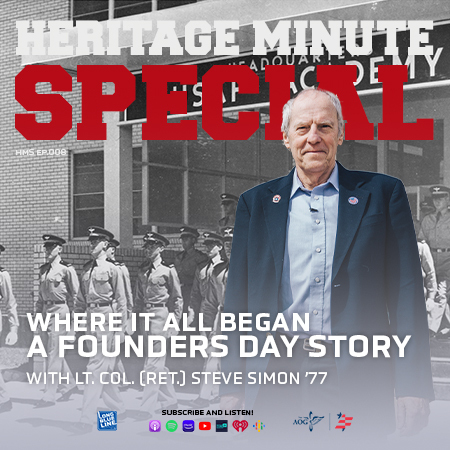
April 1, 1954 is the day President Dwight D. Eisenhower shook hands with then Secretary of the Air Force, Harold E. Talbott. The president had just signed legislation authorizing the establishment of the U.S. Air Force Academy. USAFA’s Founders Day has been celebrated on April 1 ever since.
(Left Image) President Dwight D. Eisenhower (seated) shakes hands with Secretary of the Air Force Harold E. Talbott on April 1, 1954, after signing legislation authorizing the establishment of the U.S. Air Force Academy. Looking on (from left) are Congressman Carl Vinson, Georgia; Gen. Nathan F. Twining, Air Force chief of staff; Congressman Dewey Short, Missouri, chairman of the House Armed Services Committee; James H. Douglas, undersecretary of the Air Force, and Lt. Gen. Hubert R. Harmon, special assistant for the Academy.
- (Photo courtesy U.S. Air Force Academy McDermott Library Archives)
(Right Image) The first class of Air Force Academy cadets at the Academy's first home, Lowery AFB, Denver, CO.
The Heritage Minute Channel is a production of the Long Blue Line Podcast Network and presented by the U.S. Air Force Academy Association and Foundation