Episodes

Mar 15, 2026
Mar 15, 2026
16 min
The U.S. Air Force Academy’s history didn’t begin in the 1950s.
In this edition of Heritage Minute Special, Col. (Ret.) Jack Anthony ’78 discusses the pioneers who lived on the land before the founding of the U.S. Air Force Academy — including the McAlroy family.
Col. David McAlroy ’03 joins the conversation to reflect on discovering his family’s connection.
The Heritage Minute Channel is a production of the Long Blue Line Podcast Network and presented by the U.S. Air Force Academy Association & Foundation

Mar 1, 2026
Mar 1, 2026
2 min
Groundbreaking began in October 2023. By September 2024, employees signed the final beam at the topping out ceremony. Staff moved in May 2025 — bringing the Association & Foundation and the Falcon Foundation together under one roof.
Designed in the Academy’s modernist style, Wecker Hall features collaborative workspaces, meeting rooms and a dedicated podcast studio. Its geothermal field, rooftop solar panels and energy-efficient design support a net-zero vision — maximizing stewardship.
Named in honor of Dr. Bill Wecker ’63 and his late wife, Mary Linn, the facility reflects a commitment to growth, sustainability and the future of the Long Blue Line.

Dec 8, 2025
Dec 8, 2025
2 min
Above Arnold Hall’s main entrance stands a statue of Col. James Jabara — America’s first jet ace and the second-leading ace of the Korean War. Dedicated in 2004, this monument is closely tied to the Colonel James Jabara Award for Airmanship, an annual honor established in 1967 and presented by the U.S. Air Force Academy, the Association of Graduates and the Jabara family. The award goes to a USAFA graduate, living or deceased, whose actions directly associated with an aerospace vehicle set him or her apart from contemporaries. The first recipient was Capt. Donald Stevens ’60 in 1968, and past honorees include Karol Bobko ’59, Steve Ritchie ’64, and Chesley “Sully” Sullenberger ’73.

Nov 16, 2025
Nov 16, 2025
2 min
With the unpredictable weather here at the Academy, having an indoor athletic training facility is a near necessity. The Holaday Athletic Center has capably served that purpose for more than a decade. The 92,000 square-foot multi-purpose building cost $15.5 million, all of which came from private donations. The center was the first major project for the USAFA Endowment, the fund-raising organization established in 2007 and now known as the Air Force Academy Foundation. Lynn and Bart Holaday, Class of ’65, made the lead gift of five million dollars. Ground was broken for the structure on 1 October 2010. The ceremony made for a somber event, however, as Lynn Holaday had passed away earlier that morning after a long struggle with Lou Gehrig’s disease. The building that bears her name was ready to go exactly nine months and twenty-one days later, with the dedication ceremony taking place on 22 July 2011. The Holaday Athletic Center can accommodate football, lacrosse, and soccer, in addition to other athletic activities. In fact, its value to the Academy far exceeds athletics. For example, in the past few years, it has served as the arrival point for the new classes as they report to the Academy for in-processing and Basic Cadet Training. The facility is bare bones, as it does not include heating or cooling. Air flow is provided by those Big Ass fans up there. Yep, the name of the company that made them is Big Ass Fans.

Oct 5, 2025
Oct 5, 2025
2 min
In between Vandenberg and Fairchild Halls, in the shadow of the Core Values Ramp, is the green oasis known as the Mall of Heroes. This mini-park is the gift of the Class of 1964. It features statues of three Academy legends. The first statue to be dedicated was that of First Lieutenant Karl Richter, Class of ’64, who was shot down and killed on 28 July 1967 during his 198th combat mission in Vietnam. The Richter statue was dedicated on 27 May 2008, just before the Class of ’08 graduated, as Richter was the class’s exemplar. It would be eighteen months until more statues were added, causing some cadet comedians of the time to call the area “The Mall of Hero.” Before long, however, Lieutenant Richter had company. On 6 November 2009, during its 45-year reunion, the Class of ’64 dedicated and ceremonially donated to the Academy the Mall of Heroes. The ceremony included the unveiling of two new statues, honoring Captain Valmore Bourque, Class of ’60, the first Academy graduate killed in combat, and Captain Lance Sijan, Class of ’65, the first Academy graduate to receive the Medal of Honor. Since then, as cadets march down the ramp and past this area en route to the Stillman Parade Field, they execute an Eyes Right and salute these icons.

Aug 3, 2025
Aug 3, 2025
2 min
Do you know who the U.S. Air Force Academy’s Stillman Field is named after? What about the milestones that take place there? Do you know what the mass of lush green grass’s name was before, in 1994, it earned its current moniker? Find the answers to these questions (and more you didn’t know you had) in this Heritage Minute.

Apr 20, 2025
Apr 20, 2025
1 min
The Air Force Academy cemetery is the only active base cemetery in the Air Force. In that regard, the USAFA cemetery is similar to the West Point and Annapolis cemeteries, which are also operated by their parent services, and the Arlington National Cemetery, which is administered by the Army. Consequently, the Academy cemetery has unique criteria for burial eligibility is outlined in Headquarters United States Air Force Academy instruction 34-501, which was published on 13 November, 2018. There are several exceptions and qualifiers, but the main categories of people eligible for burial at USAFA are USAFA cadets, Air Force military personnel assigned at USAFA at the time of their deaths. USAFA graduates all active duty and retired Air Force four star generals and lieutenant generals, specific former Academy senior staffers, original cadre from the Lowry days and mid-70s air training officers who supported the enrollment of the first female cadets, specific relatives of eligible members and Medal of Honor and Air Force Cross recipients. The instruction also has a waiver process. The 10th Air Base Wing Commander can disapprove a request for exception, but only the superintendent can approve an exception. These criteria and acres of space to expand ensure that eligible individuals can continue to be buried here far into the future.
The Heritage Minute Channel is a production of the Long Blue Line Podcast Network and presented by the U.S. Air Force Academy Association and Foundation

Apr 20, 2025
Apr 20, 2025
2 min
The Air Force Academy cemetery has breathtaking natural beauty and an exceptionally impressive roster of people who have chosen it as their final resting place. It also holds a large number of important structures. Most visible is the memorial pavilion. After many years of events being negatively impacted by inclement weather on 11-May, 2007, this facility, funded by the Association of Graduates, was dedicated at the time. The $4.7 million structure, funded by more than 11,000 graduates and friends, was the largest single gift ever made to the Academy. Other structures at the cemetery include the locator building with the same architecture as the memorial pavilion. It contains kiosks allowing visitors to locate any grave marker and learn about the lives of the deceased. The Memorial Wall, dedicated in 1981, contains plaques from air related units, commemorating their service and acknowledging their comrades who died as a result of combat. The 40 foot tall American Legion Memorial tower was also dedicated in 1981 in memory of those who have served their country from the Revolutionary War to the present. The tower was originally located on the Hill west of the Cadet Chapel. It was moved here in October 1996. A bronze sculpture of an Air Force honor guard was installed in October 2007. The eight foot tall statue, a gift from Mr. Ross Perot, is a replica of the Statue of the United States Air Force Memorial in Washington, DC. The Airman on the Meadow and Winged Refuge statues located near the memorial pavilion were dedicated in November 2011. The uplifted arm of the airmen evokes the John Gillespie McGee poem, High Flight, while the Winged Refuge is a set of 17 1/2' foot Art Deco wings that honor aviation and its relevance to the Academy. Mission.
The Heritage Minute Channel is a production of the Long Blue Line Podcast Network and presented by the U.S. Air Force Academy Association and Foundation

Apr 13, 2025
Apr 13, 2025
2 min
The Air Force Academy cemetery is a somber and dignified focal point of the Academy's commitment to those who have gone before. It opened in September 1958 shortly after the cadet wing moved from Lowery Air Force base in Denver to its permanent location here, north of Colorado Springs. One gage of the facility's stature and importance is the people who have chosen it as their final resting place.
Appropriately, Lieutenant General Hubert Harmon, the Academy's first superintendent, was the first person buried here. He has since been joined by an impressive roster of Air Force and Academy leaders.
At the risk of omitting noteworthy individuals. Here are some of those who are buried here.
General Carl Spots, the first Chief of Staff of the Air Force. Three other chiefs of staff, Generals Curtis LeMay, John McConnell and John Ryan.
Eight superintendents, including the first six, Captain Valmore Bork, Class of '60, the first graduate killed in combat. He shares this hallowed ground with dozens of other graduates and heroes who gave their lives in defense of the United States. Master Sergeant William Crawford, United States Army, the only Medal of Honor recipient in the cemetery and the first enlisted person to be buried here. Notably, he was a janitor in Sijan Hall, a cadet dormitory when a classmate of mine, Cadet Jim Moschgat, uncovered his story while reading about World War II; Lieutenant Colonel Theodore Harris, Korean War POW held in solitary confinement for 14 months, and author of the Contrails quote, “Many of us learned as doolies, if I can't go back with my self respect, I won't go back at all.” Colonel Lee Black, the first Preparatory School commander; Captain Charles Bush, Class of '63, the first black graduate; Brigadier General Robin Olds, triple ace and former commandant of cadets. A 100 acre site has room to grow in hopes of serving graduates and heroes long into the future.
The Heritage Minute Channel is a production of the Long Blue Line Podcast Network and presented by the U.S. Air Force Academy Association and Foundation

Apr 6, 2025
Apr 6, 2025
1 min
Traveling around the 18,500-acre Air Force Academy campus, one can see breathtaking natural scenery, modern architecture, and tributes to Air Force and Academy pioneers.

Mar 16, 2025
Mar 16, 2025
2 min
Located just west of the Service and Supply Area at the south end of the Academy is Ice Lake. A century ago, it was bustling with industry.

Mar 9, 2025
Mar 9, 2025
14 min
In this edition of Heritage Minute Special, host Lt. Col. (Ret.) Steve Simon ’77 is holding a reunion of sorts.

Mar 2, 2025
Mar 2, 2025
2 min
Tucked away in the Douglass Valley woods, along the stretch of the Falcon Trail between the Community Center and Falcon Stadium is the oldest structure on the Academy and one of the oldest in the Pikes Peak region.

Feb 2, 2025
Feb 2, 2025
2 min
There is an artifact in the Academy’s Community Center area that predates the Academy by more than 140 years.
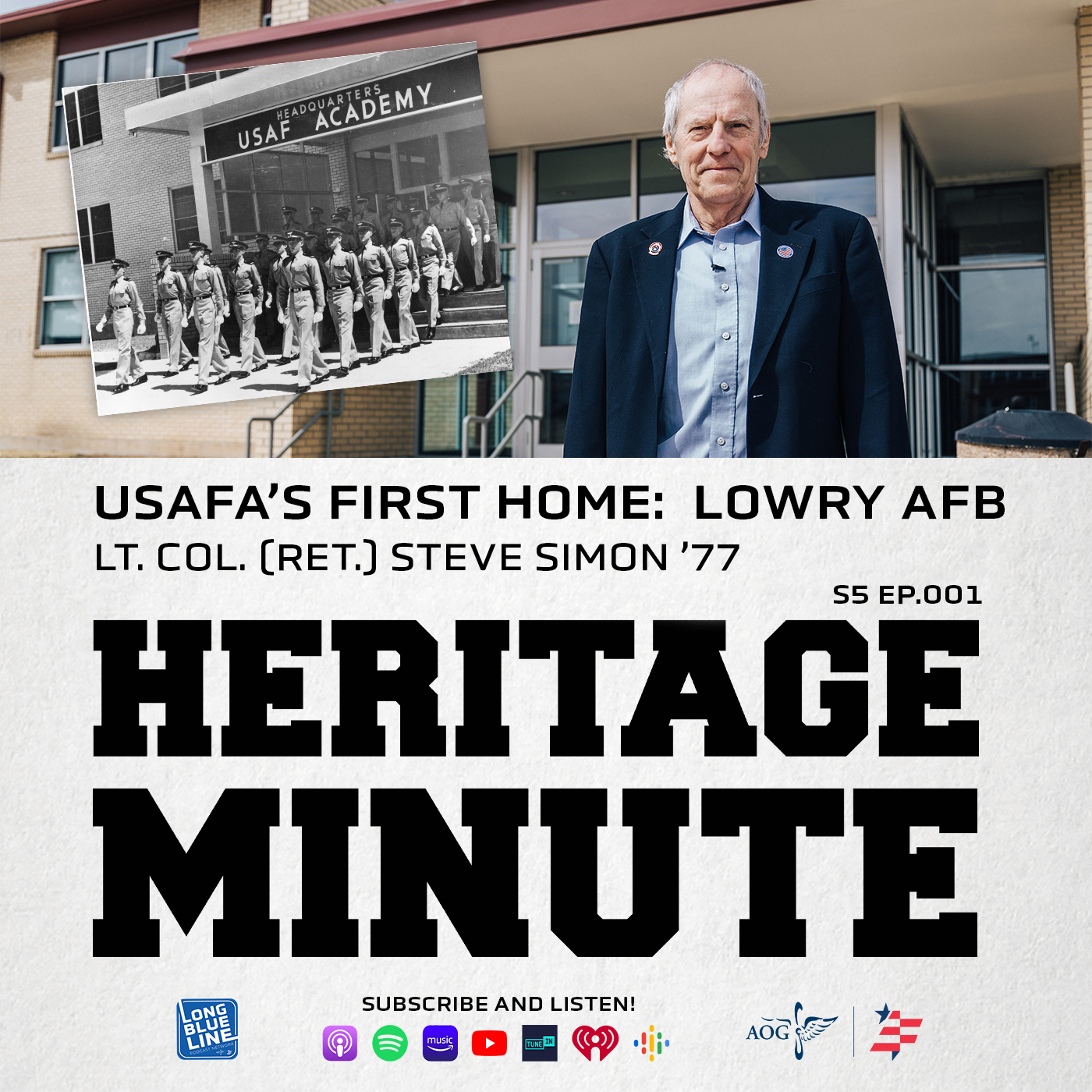
Jan 19, 2025
Jan 19, 2025
3 min
This is where it all began. July eleventh, 1955, 306 basic cadets arrived at Lowry Air Force Base in Denver, Colorado, to begin their journey at the United States Air Force Academy.